

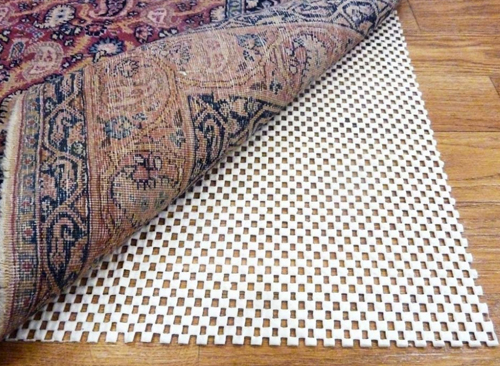
When you purchase a beautiful area rug for your Palm Desert home, the focus is usually on the pattern, the color, and the texture. The rug pad—that boring sheet of rubber or felt that goes underneath—is often an afterthought, or skipped entirely to save money. This is a mistake.
In the world of rug care, a high-quality pad is not an accessory; it is a necessity. It serves as the shock absorber for your rug. Without a pad, your rug is being ground against the hard surface of your tile or stone flooring every time you walk on it. This friction accelerates wear, causing the knots to loosen and the pile to flatten. Investing in a proper pad is the single most effective way to double the lifespan of your textile investment, while also protecting the expensive flooring underneath.
Safety First: Preventing the “Slip and Slide”
The most immediate benefit of a rug pad is safety. In many Coachella Valley homes, polished travertine, marble, or hardwood floors can turn an unsecured rug into a skating rink. A loose rug is a major tripping hazard, particularly for seniors or young children.
A quality pad provides the necessary grip to anchor the rug firmly to the floor. However, not all pads are created equal. Cheap, waffle-weave pads from big-box stores often contain clay fillers that break down over time, turning into a powdery mess or, worse, reacting with your floor finish and sticking to it permanently. We recommend rubber-backed felt pads. The rubber provides the grip, while the felt provides the structure. According to the National Safety Council, falls are a leading cause of injury in the home, and securing loose throw rugs is one of their top recommendations for injury prevention.
The “Buffer” Effect: Protecting the Foundation
Beyond safety, a pad acts as a buffer. When you step on a rug that is laying directly on concrete or tile, the fibers are crushed between the heavy impact of your foot and the unforgiving floor. This is like hitting a hammer against an anvil; something has to give, and it is usually the wool fiber.
A felt pad provides a layer of compression. When you step, the pad compresses, allowing the rug fibers to flex rather than crush. This preserves the “loft” or fluffiness of the pile. Furthermore, the pad creates a tiny air gap between the rug and the floor. This airflow allows moisture to dissipate and makes vacuuming more effective. When you vacuum a rug with a pad, the suction lifts the rug slightly, allowing air to be pulled through the rug, extracting more dust. Without a pad, the vacuum just sucks the rug against the hard floor, cleaning only the very top surface.
Protecting Your Floors from “Scratch and Stain”
Finally, we must consider the floor itself. The back of a hand-knotted rug can be quite abrasive—think of it as a mild sandpaper made of dried cotton knots. Over years of shifting, this can scratch delicate wood or etch polished stone finishes.
Additionally, a pad acts as a “first responder” during a spill. If a pet has an accident or a glass of wine spills, a dense felt pad can absorb some of the liquid before it reaches your porous stone or hardwood floor. While it doesn’t solve the stain issue completely, that extra barrier can be the difference between a rug cleaning bill and a floor refinishing bill. Resources like Floor Covering News highlight that underlayment is critical for protecting the warranty and finish of hard surface flooring.
Your Palm Desert Experts for Rug Care
We don’t just clean rugs; we help you construct a system that preserves them. We offer custom-cut, high-quality pads that protect your family and your floors. Trust Magic Rug Cleaners for holistic rug care. Learn more about our preservation techniques in our Rug Cleaning Services section or reach out via our Contact Us page.